
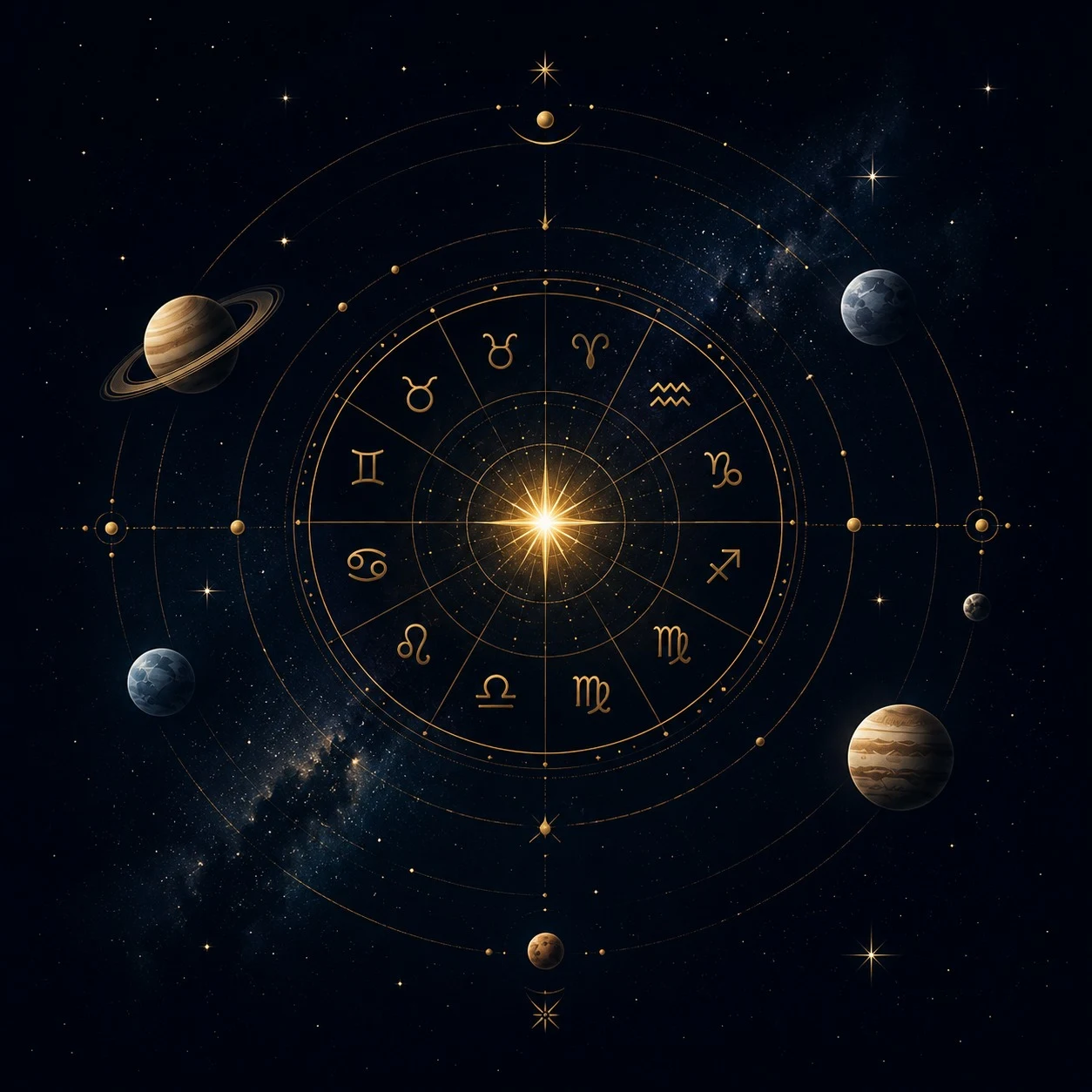
A kundli, or Vedic birth chart, is a snapshot of where the Sun, Moon and planets stood at the exact moment and place you were born. Reading it well means moving through it in layers: the foundations of the chart, then each of the twelve houses, then the special combinations called yogas, and finally the timing of life periods. This guide walks through those layers so you know what a complete reading actually involves.
What a kundli is made of
Every kundli rests on three building blocks. The twelve signs (rashis) are the zodiac, measured in Vedic astrology against the fixed stars using a sidereal calculation. The nine grahas are the Sun, Moon, Mars, Mercury, Jupiter, Venus, Saturn and the two lunar nodes, Rahu and Ketu. The twelve houses (bhavas) are the areas of life, counted from the ascendant, or Lagna, the sign rising on the eastern horizon at birth.
The Lagna sets the frame for everything else. It moves through all twelve signs in a day, which is why two people born on the same date but a few hours apart can have very different charts. The Moon's sign and its nakshatra, one of 27 lunar mansions, describe your emotional nature and also decide where your dasha sequence begins.
The twelve houses, one by one
Each house governs a set of life themes. In brief:
- 1st: self, body and vitality
- 2nd: wealth, speech and family
- 3rd: courage, effort and siblings
- 4th: home, mother, property and inner peace
- 5th: intelligence, children and past merit
- 6th: daily work, health routines and competition
- 7th: marriage and partnership
- 8th: transformation, shared resources and research
- 9th: fortune, dharma, father and teachers
- 10th: career and public standing
- 11th: income, gains and networks
- 12th: expenditure, foreign lands and liberation
A house is never read from its sign alone. An astrologer looks at the sign on the house, the planet that rules that sign (the house lord) and where that lord sits, any planets occupying the house, the planets aspecting it, and its strength. The same 7th house can read very differently when its lord sits in a strong angle compared with a hidden house.
Divisional charts, yogas and planetary strength
The main chart (D1) is supported by divisional charts, or vargas, which magnify one area of life. The Navamsa (D9) is read for inner strength and marriage, the Dashamsha (D10) for career, the Saptamsha (D7) for children and creative legacy, and the Shashtiamsha (D60) is traditionally linked to karmic inheritance. The finer the division, the more sensitive it is to birth time: the D60 can change with only a couple of minutes' difference.
Yogas are specific combinations of planets and house lords. Raja yogas, for example, form when lords of the angular houses (1st, 4th, 7th, 10th) connect with lords of the trinal houses (1st, 5th, 9th). Dhana yogas link the lords of wealth houses. A yoga only counts if the chart actually forms it, and its results depend on the strength of the planets involved.
Strength is measured with Shadbala, a six-fold calculation of each planet's strength that includes its position, direction, timing and motion, and with Ashtakavarga, a point system that grades how well each house is supported.
Timing: the Vimshottari dasha
Vedic astrology times events through the Vimshottari dasha, a 120-year cycle of planetary periods. Each planet rules a fixed span: Ketu 7 years, Venus 20, Sun 6, Moon 10, Mars 7, Rahu 18, Jupiter 16, Saturn 19 and Mercury 17. Your sequence starts from the lord of your birth nakshatra, and each major period (Mahadasha) divides into sub-periods (Antardashas). A period tends to activate the houses its planet rules and occupies, while the slow transits of Jupiter, Saturn and Rahu show the shorter rhythms within it.
What a reading can and cannot tell you
A kundli describes tendencies, strengths and timing. It cannot fix your choices or guarantee events, and a good reading never claims to. A few common myths are worth setting aside:
- A dosha, such as Manglik, is not a verdict. Its presence must be checked properly, and traditional cancellations often apply.
- One weak planet does not spoil a chart. Every chart has strong and weak points, and the reading weighs them together.
- Health themes in a chart describe constitution and energy, never a diagnosis. Astrology is not a substitute for medical care.
Remedies and daily practice
Traditional remedies are optional practices that help you work with a planet's themes: a mantra for the planet, charity on its weekday, steady routines, or fasting. They are best tied to the planets that are genuinely weak in your chart. Gemstones are a stronger step and should be considered only after consulting a qualified astrologer. No remedy cancels a placement; the aim is steadiness and awareness.
What the Oracular Premium Personalized Kundli covers
The Premium Personalized Kundli is a 30+ page reading built from your exact birth chart, calculated with sidereal (Lahiri) positions and the Vimshottari dasha. Its thirty-odd sections follow a deliberate order:
- Your full chart set: Lagna (D1), Navamsa (D9), career (D10), progeny (D7) and karma (D60) charts
- All twelve houses interpreted individually, from self and wealth through to liberation
- The yogas and raja yogas actually present in your chart, with Shadbala planetary strengths
- Manglik and dosha analysis, marked present or absent from your real chart, never guessed
- Your complete 120-year Vimshottari dasha timeline, your current period and the year ahead
- Remedies tied to your weakest planets, and a three-step daily routine you can keep
The report is written from your computed chart data and reviewed by an astrologer before it is sent. It arrives within 24 to 72 hours as a web report and a PDF.
It suits you if you want one thorough reference for your whole chart rather than a single topic, or if you have a free chart but no one has ever explained it to you. Have a look at the sample to see how the sections read.