
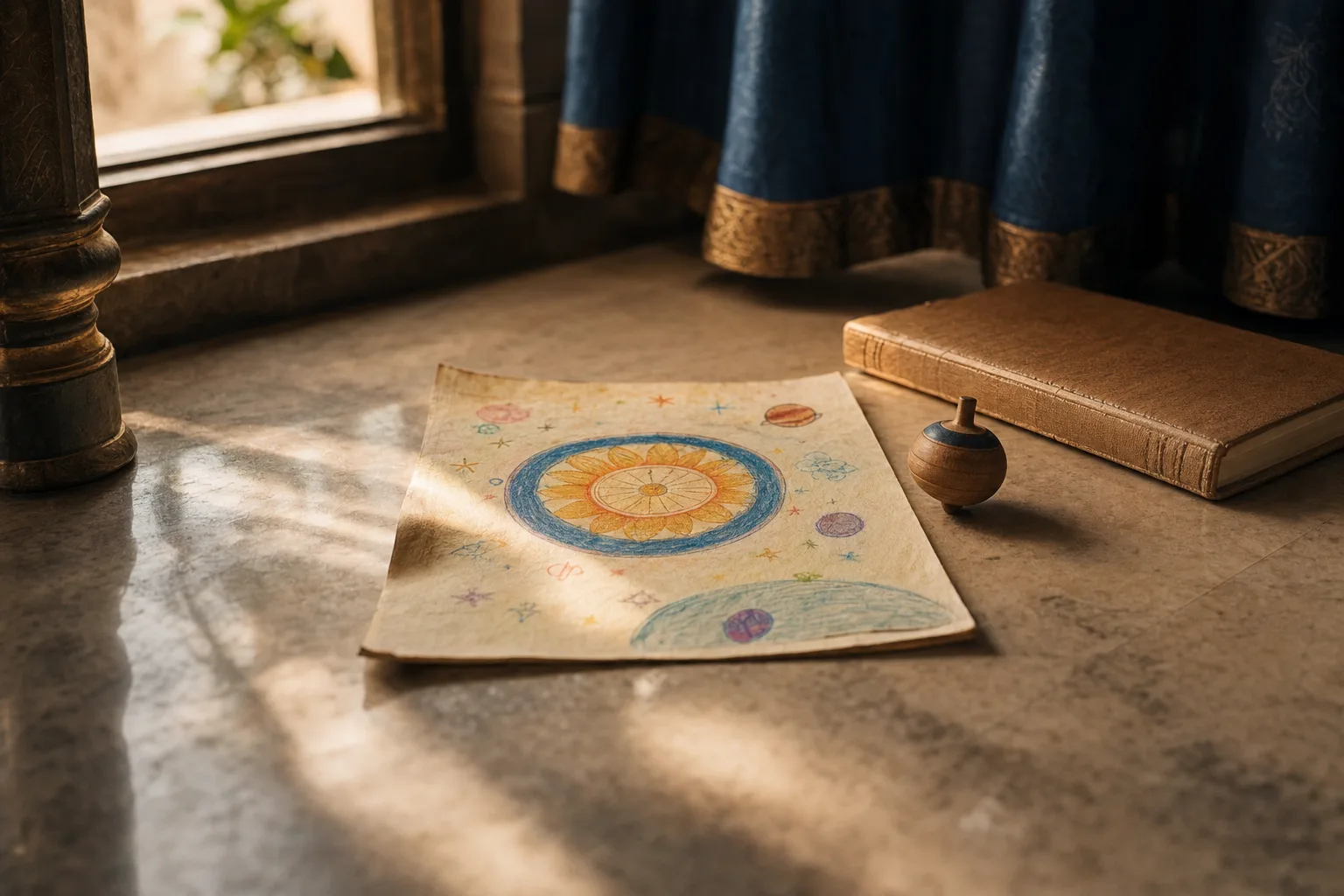
Every parent learns quickly that their child arrived as someone. One baby settles in a busy room, another needs quiet; one toddler builds for an hour, another wants to run. Vedic astrology has long been used to describe these inborn leanings, and read carefully it can help a parent see their child more clearly. This guide explains how that reading works, where its limits are, and how to use it kindly.
Temperament in Vedic astrology
In Jyotish, a birth chart is a map of the sky at the moment of birth, and different parts of it describe different layers of a person. For a child, three layers matter most.
The Lagna, or ascendant, describes the outer self: how a child meets the world, their physical energy and the impression they make in a new place. The Moon describes the inner, emotional life: what soothes them, what unsettles them and how they recover after a hard moment. When the Lagna and the Moon point in different directions, that gap often explains why a child seems easy-going in company yet runs hot inside. The Navamsa, the ninth divisional chart, is traditionally read as showing the deeper strength of each planet, confirming or softening what the main chart suggests.
Beyond these, astrologers look at the elemental balance of the signs (fire, earth, air and water), the Moon's nakshatra, and the planets connected with learning and creativity, especially Mercury and the fifth house.
How a child's chart is read for strengths
A careful reading does not pick one planet and declare a talent. It looks for where energy concentrates: which themes are supported by several factors at once, and which are only lightly marked.
For example, a chart where Mercury is strong and the air signs are emphasised often describes a child who learns by talking things through and gets restless with silent repetition. A chart with a strong Moon in a water sign often describes a child who notices moods in a room before anyone speaks. These are tendencies, not instructions.
An honest reading also names what each strength costs. A child who absorbs everything around them may also tire faster in noise. A child with a fierce drive to finish things may find interruptions genuinely painful. Seeing the cost alongside the gift is what makes a reading useful rather than flattering.
What it can and cannot tell you
A birth chart can offer a vocabulary for what you already half-see in your child, and sometimes it points to something you had not noticed. It cannot tell you what your child will become, what marks they will get or which career they will follow. It is one lens among many, alongside your own observation, their teachers, their health and, above all, the child themselves.
A few myths are worth setting aside:
- A chart does not label a child as good or difficult. Every temperament has its own strengths and its own costs.
- Strengths are not fixed destinies. A leaning towards music or numbers is something to feed, not a box to keep a child in.
- Nothing in a chart replaces professional advice. If you have concerns about your child's development or wellbeing, speak to a paediatrician or a qualified specialist.
Using the reading at home
The most practical use of a temperament reading is small and daily. If your child recharges alone, protect a little quiet time after school. If they think aloud, give them someone to think aloud with. If overwhelm shows up as anger rather than tears, you will respond better once you recognise it.
Children also respond deeply to being seen accurately. There is a real difference between praise ("you are so clever") and recognition ("you kept going with that puzzle even when it got hard"). Recognition tells a child that you notice how they work, and it gives them language for themselves.
Some families also enjoy traditional practices, such as a simple shared prayer or a regular act of giving. These are optional and are about family rhythm, not about changing a child's chart.
What the Oracular Talent & Temperament Profile covers
The Talent & Temperament Profile is a warm, specific profile of one child built from their exact birth chart, for ages 0–17. The chart is calculated in the sidereal zodiac with Lahiri ayanamsa, but the astrology stays in the engine: what you read is behaviour you will recognise from this week, not a list of planets and houses.
It opens with what your child leads with, moves through how they learn and where they struggle, and closes with five sentences you can say out loud to them. Inside you will find:
- A scored talent map showing where their energy actually concentrates, ranked, with the cost each strength carries
- How they learn, how they rest, and what overwhelm looks like in them specifically
- What they need from you that they cannot yet ask for
- Five concrete things to do this week, as actions rather than principles
- Five sentences to say to them, built on recognition rather than praise
- The full birth chart the reading was computed from, including positions, panchang, Lagna and Navamsa
It is written for the age your child is now, not for children in general. It makes no predictions about careers or outcomes, and nothing in it diagnoses, ranks or compares your child to other children. The writing is generated from computed chart data and reviewed by an astrologer before delivery, and it arrives as a web report and a PDF within 24–72 hours.
Who the Talent & Temperament Profile suits
This profile suits parents who want to understand the child in front of them, whether that child is a baby, a busy seven-year-old or a quiet teenager. It is especially helpful when a child's behaviour puzzles you, when siblings seem to need completely different things, or when you simply want words for what you already sense. You will need your child's date, exact time and place of birth. Have a look at the sample to see how the profile reads.