
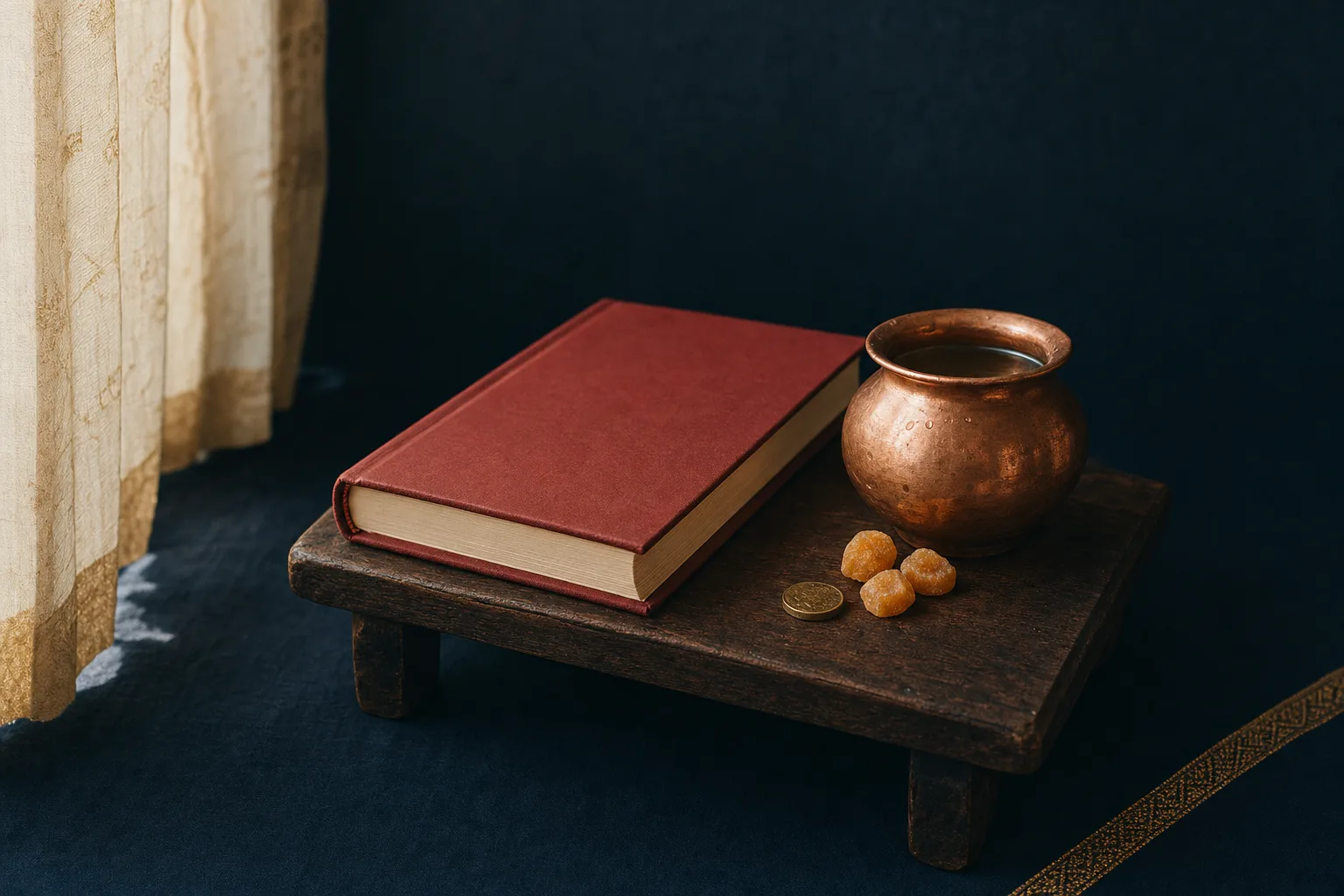
Lal Kitab, the "red book", is one of the most loved and least understood branches of Indian astrology. It reads your chart through a fixed set of houses, looks for karmic debts carried in the family line, and offers remedies so simple that most of them cost almost nothing. This guide explains how it works, what it can and cannot tell you, and how its upay are traditionally done.
What Lal Kitab is
Lal Kitab is a body of astrological and palmistry writing first published in Urdu between the late 1930s and early 1950s, usually attributed to Pandit Roop Chand Joshi. It grew out of the Vedic tradition but developed its own rules, its own vocabulary and a strongly practical tone. Where classical texts often describe a placement and stop there, Lal Kitab almost always asks: what can you do about it today?
Its appeal lies in that directness. The remedies, called upay, use everyday things such as water, food, coins and small acts of kindness. The aim is to steady a planet through conduct and habit, not through expensive ritual.
The fixed-house system and pakka ghar
The first thing that sets Lal Kitab apart is how it builds the chart. Your planets are still calculated from your birth date, time and place, but they are then placed on a fixed wheel where house 1 is always treated as Aries, house 2 as Taurus, and so on around to house 12 as Pisces. A planet is read by its house number, not by the sign it happens to be in.
Each house therefore has a fixed lord. House 1 belongs to Mars, house 2 to Venus, house 3 to Mercury, house 4 to the Moon, house 5 to the Sun, house 6 to Mercury, house 7 to Venus, house 8 to Mars, house 9 to Jupiter, houses 10 and 11 to Saturn, and house 12 to Jupiter.
Pakka ghar, the permanent house
Every planet also has a pakka ghar, a house where it is considered naturally settled. The Sun's pakka ghar is house 1, the Moon's is house 4, Mercury's and Venus's is house 7, Rahu's is house 12 and Ketu's is house 6. Mars is at home in houses 3 and 8, Saturn in houses 8 and 10, and Jupiter in houses 2, 5, 9 and 12. A planet in its pakka ghar tends to give its results steadily. Lal Kitab also uses house-based exaltation and debilitation (uchcha and neecha), and an empty house is read through the house where its fixed lord sits.
Rin: the karmic debts
Lal Kitab speaks of rin, inherited debts that show up as recurring patterns in a family until someone takes responsibility for them. Commonly listed ones include Pitri Rin (ancestral debt), Matri Rin (debt to the mother), Stri Rin (debt to the women of the family), Bandhu Rin (debt to relatives), the debt to sisters and daughters, Zalim Rin (the debt of harshness) and Ajanma Rin (the debt of the unborn). Each is triggered by specific planets in specific houses.
The traditional remedy for a rin is usually collective: family members contribute equally towards one shared act of charity or service. The idea is gentle and practical. A debt is something you settle, not something you fear.
What Lal Kitab can and cannot tell you
Lal Kitab is good at turning a chart into everyday guidance: how to conduct yourself at home, what to keep or avoid, which relationships to tend. It is far less concerned with exact timing than Parashari astrology, and it does not use the Vimshottari dasha in the same way.
A few common myths are worth setting aside:
- Not everyone carries a karmic debt. Many charts show none of the classical rin at all.
- More remedies are not better. Lal Kitab warns against doing several upay at once.
- An upay is not a guarantee. It is a traditional supportive practice that works alongside your own effort and choices.
- A remedy for one planet can harm another. Lal Kitab, for example, advises against donating the items of a planet that is exalted or in its pakka ghar.
How upay are traditionally done
Lal Kitab upay follow a simple discipline. Choose one, do it every day for 43 days, preferably in daylight, and do not skip. If a day is missed, begin again. Only once one upay is complete should you start the next.
Typical upay include feeding a particular animal, keeping a certain object at home, offering water, or giving a small item in charity on a specific day of the week. None of them requires a paid ritual. Keep them optional and keep them light: they are a way of paying steady attention to one part of your life, not a test you can fail.
What the Oracular Lal Kitab Reading covers
The Oracular report first sets out your chart on the Lal Kitab fixed-house system, calculated with sidereal (Lahiri) positions. It then reads each house in turn, self and family, children and marriage, fortune, work and gains, with every planet checked against its pakka ghar.
From there it covers career, money, family, children and marriage the Lal Kitab way. It names only the karmic debts your chart actually shows and explains what each asks of you; if none apply, it says so. You then receive at most three upay chosen for your placements, simple, inexpensive and traditional, with the 43-day method and clear do's and don'ts for each. The report closes with Lal Kitab precautions for your placements and a practical focus for the coming year.
The report is written from your computed chart data, reviewed by an astrologer, and delivered as a web report and PDF within 24 to 72 hours.
Who it suits
This reading suits you if you have heard about Lal Kitab from family and want to know what it says about your own chart, if you prefer a few practical steps to a long list of predictions, or if you want remedies that fit into an ordinary day. It is also a good companion to a standard kundli reading, because it looks at the same planets from a very different angle. Take a look at the sample to see how a Lal Kitab reading is laid out.